
Difference Between Centralized and Modular Battery Management System (BMS)
Improve Battery Management Efficiency with BMS
A Battery Management System (BMS) is crucial for monitoring and controlling battery packs, especially in applications like Electric Vehicles (EVs), energy storage systems and portable electronic devices.
There are two main types of BMS architectures: centralized and distributed/modular systems. Each architecture has its advantages and disadvantages, and the choice between centralized and modular architectures impacts how the system monitors and manages the battery packs.
In a modular BMS configuration, the system battery pack is partitioned into multiple identical modules. A modular BMS incorporates the monitoring and balancing functions directly into the battery cells or modules. Each module has its own BMS circuitry that can manage the cells within it. These modules then communicate with a master BMS unit. The central controller does not directly engage in cell monitoring or control; instead, it focuses on higher-level functions such as system-wide State of Change (SOC) calculations, detecting and isolating faults, etc.
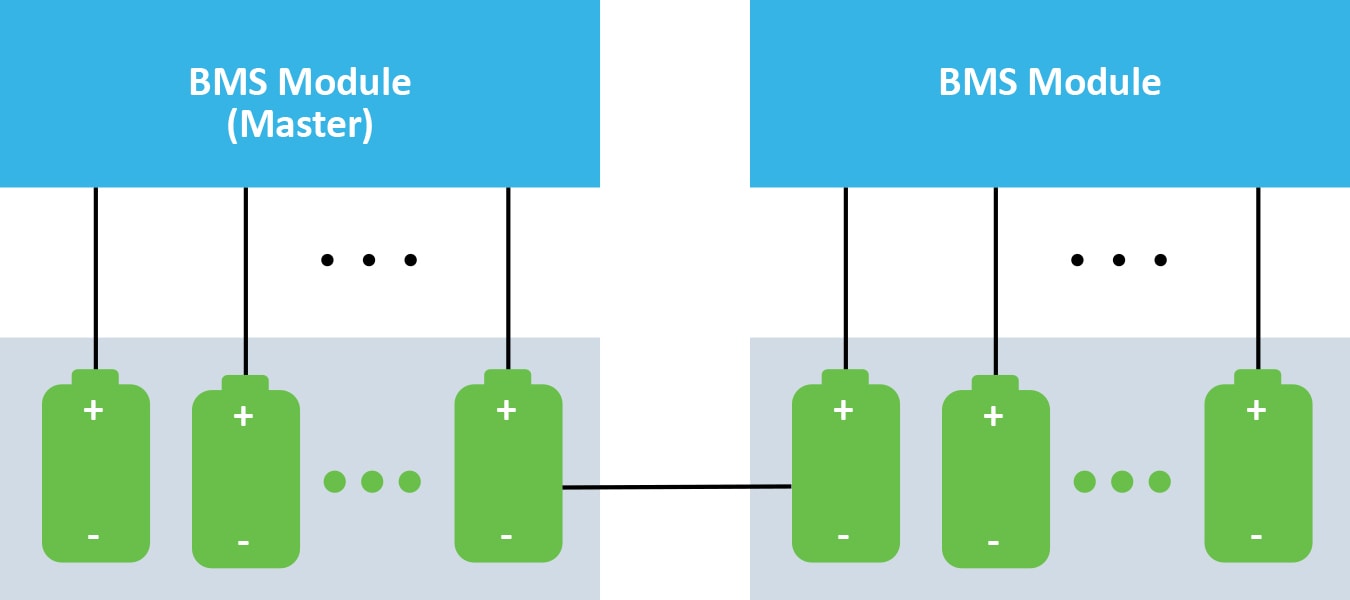 |
On the other hand, a centralized BMS has a single, central unit that manages all the functions related to monitoring and protecting the battery pack. This central unit is responsible for tasks such as: measuring cell voltages and temperatures, SOC, State of Health (SOH) and controlling the cell balancing, as well as protecting the battery by ensuring it operates within safe limits. All the sensors and balancing circuits from the individual cells or cell modules are wired back to this central unit.
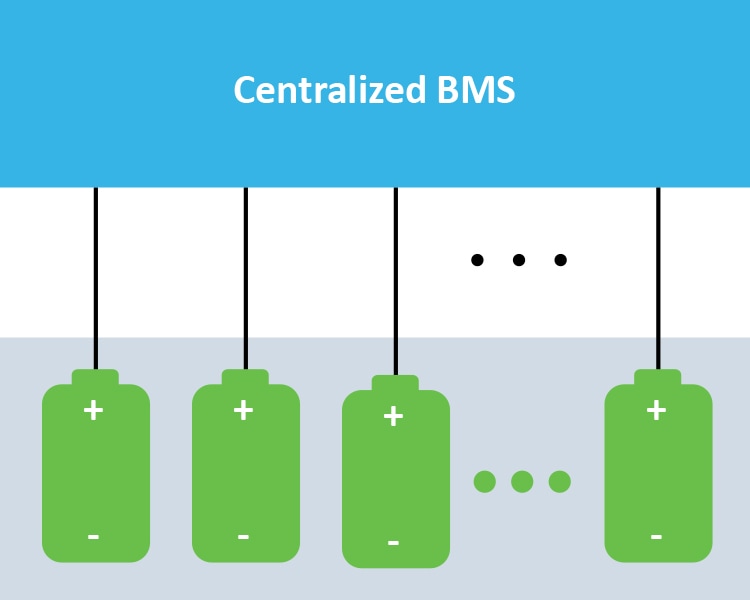 |
As mentioned, each architecture has its advantages and disadvantages.
The advantages of a modular BMS are:
Scalability: Modular and distributed BMSs are highly scalable. Additional modules can be added to the system without significantly altering the existing configuration, making it easier to expand the battery capacity and to make modifications to existing architecture.
Flexibility: They offer more flexibility in terms of battery pack design. Since each module has its own BMS, it can be designed to fit into irregular spaces within a product, which is particularly useful in custom battery pack designs and architecture.
Thermal Management: With a distributed or modular BMS, thermal management can be more effective because each module can be monitored and controlled independently, allowing for more precise temperature regulation.
Redundancy and Fault Tolerance: A distributed or modular system can offer redundancy; if one BMS unit fails, others can continue to operate, which can be critical in applications where safety and uptime are paramount. In addition, if one module fails, it can be isolated without affecting the rest of the battery pack. This can enhance the overall reliability of the system.
Maintenance and Serviceability: Individual modules can be replaced or serviced without taking the entire battery system offline, which can be advantageous in large-scale energy storage or EV applications.
The advantages of a centralized BMS are:
Cost: Centralized BMSs can be less expensive because they use fewer components and less complex wiring than distributed or modular systems.
Simplicity: A centralized BMS is generally simpler to design and manufacture, as it involves a single control unit managing the entire battery pack.
Weight and Space: For some applications, a centralized BMS can save space and reduce weight because it eliminates the need for multiple control units.
Communication: With a single BMS, communication is typically more straightforward, as there is no need for inter-module communication, which can reduce the complexity of the communication protocol and the potential for errors.
Energy Efficiency: A centralized BMS may have slightly higher energy efficiency due to fewer electronics and less duplication of components which can result in lower power consumption.
Both centralized and modular BMS architectures have their own strengths and are suited to different applications based on the specific needs of the battery system and its intended use. Centralized BMS is utilized by many applications such as consumer electronics like laptops and smartphones. These devices typically use centralized BMS designs due to their relatively small footprints. The central controller manages battery health, charging and discharging for all cells in the battery pack, ensuring balanced performance and safety. On the other hand, industrial applications such as large-scale Energy Storage Systems (ESS) and Power Supply Units (PSU) energy often utilize modular BMS architectures. These systems can consist of hundreds or thousands of battery modules, and modular BMS designs allow for efficient management, scaling and redundancy.
Want More?
For more information, please visit our low voltage BMS reference design page.We offer a modular low-voltage BMS solution for various battery chemistries, including lithium-ion, lead-acid,and nickel-metal hydride. Our low voltage BMS evaluation platform demonstrates monitoring a stack of 6 to 8 series 18650 Li-Ion batteries using the PAC1952 analog front end. This battery management solution offers state-of-charge determination using all three methods demonstrated above: voltage measurement, coulomb-counting and impedance measurement to enable accurate monitoring of battery cells. In addition, this demo supports passive cell-balancing using a network of discrete FETs and resistors. It also comes with Graphical User Interface (GUI) support showing battery cells’ SOC in real time.
For higher-voltage, modular BMS, please contact us.